
Sometimes, the most powerful stories come from the quietest places. In the work of Olu Frank Idoze, creative art director of OFI Expressions and Culture Enterprise, dry straws, fragile, golden, and ordinary finds a voice. It is shaped, layered, and coaxed into life, becoming a vessel for memory, movement, and meaning. His latest series of straw artworks, which includes Evening in the Village, Essence in Motion, and The Silent Vessel, offers something rare: art that not only depicts but whispers, inviting viewers into a world of African tradition, resilience, and grace.
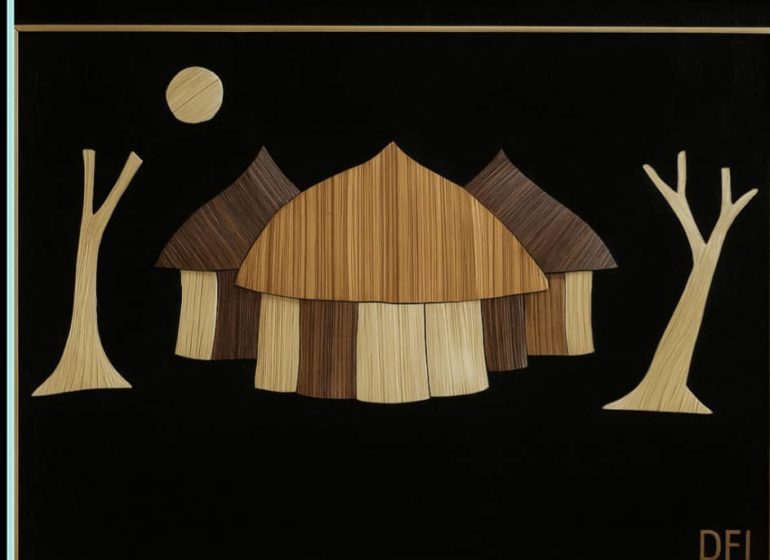
Evening in the Village sets the scene. Three thatched huts huddle under the watchful moon, flanked by stark trees that mark the passing of seasons. Against a deep black ground, the straw glows warm and alive, telling of a village where families gather at dusk, where stories and laughter rise into the night air. The piece feels both tender and timeless, a quiet celebration of belonging.
The deliberate absence of human figures is one of its most striking features. Unlike typical village depictions that emphasize social activity, Idoze isolates the space, allowing the viewer to contemplate the stillness or perhaps the absence of communal life. The dry trees, rendered in pale straw, flank the scene like sentinels, reminding us of nature’s seasonal decline. These bare forms resist romanticization, offering instead a subtle reflection on the harshness of dry seasons, cycles of hardship, or even migration.
Technically, the work is defined by balance and control. Each hut’s thatch roof is layered with slight tonal shifts from deep brown to golden beige, giving depth to what could have otherwise been a flat silhouette. The black background is not merely aesthetic; it operates as a space of memory and contrast, emphasizing the warm organic hues of straw while creating psychological depth.
While the piece is successful in evoking nostalgia and spatial memory, it may also limit itself by its restraint. The minimalism, while elegant, risks emotional detachment, a decision that could be interpreted as either meditative or overly contained. A more textural background or the inclusion of narrative indicators such as shadows, footprints, or household objects could have broadened the work’s emotional reach.
From that stillness comes Essence in Motion, a figure caught mid-dance, faceless yet unmistakably full of energy. Here, Idoze captures not just the beauty of movement but its meaning, the joy, the offering, the rhythm of African womanhood. The figure’s curved lines seem to sway with an invisible drumbeat, reminding us that dance is not just performance but prayer, freedom, and memory made physical.
Technically, the figure is crafted with careful line flow the curves of straw are placed to suggest kinetic energy. However, the background remains too passive. For a piece that speaks of motion and rhythm, the visual environment feels too still. A textured or multidimensional backdrop, even with more nuanced layering, would amplify the figure’s vitality and situate it in a more resonant space.
Perhaps the most conceptually refined piece of the trio, the Silent Vessel is an abstracted female form shaped like a sacred jar or calabash, arms flared upward in invocation or surrender. The simplicity is striking, a single figure carved in straw, radiating dignity and strength. She is at once rooted and reaching, a symbol of all the women who carry history, spirit, and the weight of generations with quiet grace.
What distinguishes this piece is its spiritual quietness. It doesn’t rely on dynamic movement or narrative cues. Instead, it offers presence. The absence of facial features removes identity to reveal essence. She is a woman not as an individual but as a vessel of life, of ancestry, of cultural wisdom.
The use of straw here is at its most symbolic: pliable yet enduring, organic yet structured. While this aesthetic decision provides coherence across the series, it also reveals the limitation of working in a single medium. A future direction might involve experimenting with straw’s contrast to other organic or textural materials bark, raffia, and charcoal, to expand its visual and symbolic register.
What ties these works together is more than the material. It is a sense of reverence for the earth, for culture, for the unseen threads that bind people to their ancestors and each other. Olu Frank Idoze takes what most would overlook, dry straw, and transforms it into something enduring, delicate yet unbreakable.
There is no spectacle here, no need to shout, as these works speak softly, but their echo lingers. Olu Frank Idoze has not merely crafted beautiful objects; he has woven a story, one of place, of memory, of resilience, and invited us to listen. In the delicate shine of straw against black, we are reminded of the strength in simplicity, the poetry in quiet things, and the power of art to make the ordinary extraordinary. In his hands, straw speaks. And what it says is unforgettable.
Copyright 2025 TheCable. All rights reserved. This material, and other digital content on this website, may not be reproduced, published, broadcast, rewritten or redistributed in whole or in part without prior express written permission from TheCable.
Follow us on twitter @Thecablestyle