
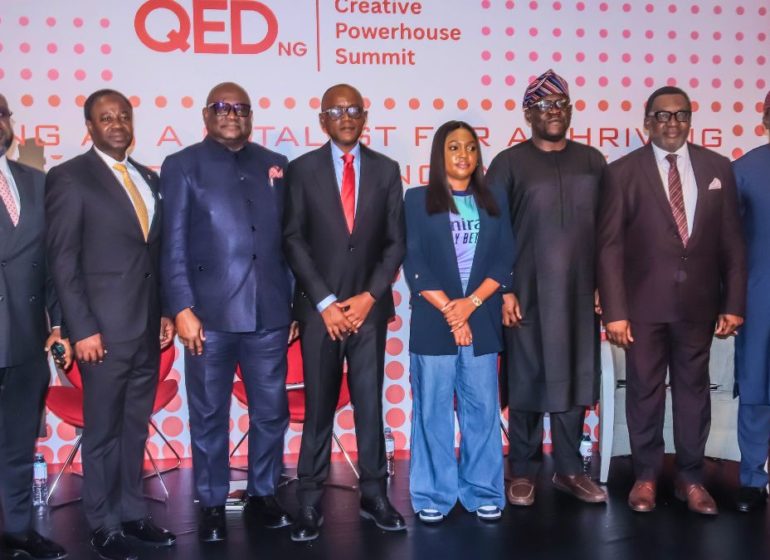
Stakeholders in Nigeria’s creative economy say the sector needs long-term funding and a change in mindset among entrepreneurs to unlock its full potential.
The stakeholders spoke on Tuesday at the maiden QEDNG Creative Powerhouse Summit held in Lagos.
The event, organised by Mighty Media Plus Network Limited, was themed ‘Financing as Catalyst for a Thriving Creative Economy’.
The summit brought together filmmakers, musicians, fashion designers, journalists, financiers, policymakers, and business leaders to discuss sustainable growth for creatives.
Olumide Iyanda, CEO of Mighty Media and convener of the summit, said the creative sector contributes “$5.6 billion to Nigeria’s GDP and is the second highest employer in the country”‘.
Iyanda, who is also the publisher of QEDNG, added that stakeholders must embrace strategic thinking and partnerships.
“The federal government has set a bold goal of raising the sector’s contribution to $100 billion by 2030. The plan seeks to position Nigeria as a leading creative and entertainment hub on the global stage,” he said.
“Talents and ideas abound, but the real challenge is turning them into something people can see, hear, touch and actually pay for.”
On his part, Udeme Ufot, chairman of the summit and group managing director of SO&U, said access to sustainable, strategic funding is critical.
He called for “smart financing” by investors who understand content development cycles, banks willing to design products for creative entrepreneurs, and policies that reward innovation and risk-taking.
“Without access to sustainable and strategic funding, creativity struggles to scale. Ideas remain trapped in notebooks. Studios shut down. Talent goes untrained,” Ufot said.
Delivering the keynote, Nkiru Balonwu, founder of The Africa Soft Power Group, said the problem is less about the absence of capital and more about the lack of scalable, structured investment frameworks.
She called for tiered financing tailored to the creative lifecycle, and emphasised investment in infrastructure such as rights management platforms, and affordable production facilities.
“This requires a mindset shift. Creatives must see themselves not just as artists but as businesspeople and institution builders,” she said.
Balonwu also urged the industry to embrace artificial intelligence as an enabler rather than a threat.
In a goodwill message, Temitope Ajayi, senior special assistant to President Bola Tinubu on media and publicity, praised the sector’s cultural export success over the past decade and urged creatives to move beyond “subsistence thinking”.
Panel discussions featured industry figures including Kunle Afolayan, Mike Dada, Mary Ephraim-Egbas, and Joseph Edgar, who all cited funding access as a persistent challenge.
The event also honoured several participants with plaques, presented by veteran journalist Maureen Chigbo, Nigerian Guild of Editors president Eze Anaba, and actress Joke Silva.
Copyright 2025 TheCable. All rights reserved. This material, and other digital content on this website, may not be reproduced, published, broadcast, rewritten or redistributed in whole or in part without prior express written permission from TheCable.
Follow us on twitter @Thecablestyle