
BY MATTHEW HASSAN KUKAH
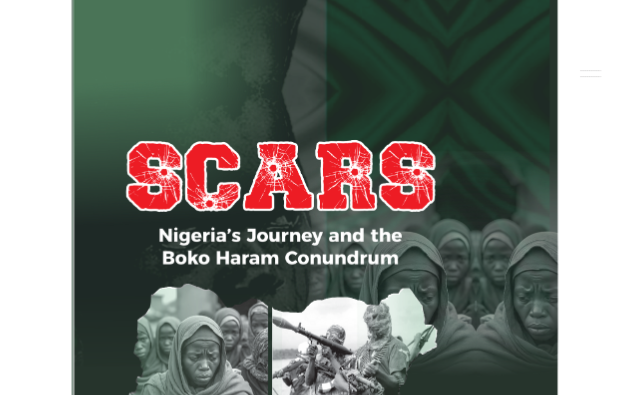
The title of the book offers the first philosophical provocation for the reader: Where do we situate Boko Haram in relation to Nigeria’s journey, and, if we may add, journey to where? In other words, is Boko Haram a forest on the road that we did not anticipate, or is it a consequence of poor map-reading on our part? If we take Boko Haram as an affliction that has left us with scars, was the injury self-inflicted or was it the injury caused by an enemy? I will forgive you for thinking that my opening remarks sound like the conclusion. However, these questions are so important because Boko Haram is etched on the blackboard of Nigeria’s scarred face.
Lucky Irabor, a retired General of the Nigerian Army, with vast experience spread across Nigeria’s tortured landscape of blood and violence, has waded into a field in which he is both a participant-observer and an actor. He has used this book to pull together a tapestry of his obviously deep theoretical knowledge and firmly formed it in the furnace of his rich field experience as an officer and a gentleman.
The book is 285 pages long and is made up of 14 chapters and a conclusion. The Foreword to the book is written by the master himself, the first General to fire the first shot by wading into the world of professional documentation of field military experience. His book, My Command, stands out as that testimony. He has remained relentless in telling his stories, things that he had control over while in power. Not unexpectedly, he has left behind in his large footprints, trails and trails of controversies in the sands of Nigeria’s history. You know by now that I am talking of General Olusegun Obasanjo. General Obasanjo’s appeal in his Foreword answers the reason why this book is so important. He said: I am hopeful that this contribution to the body of knowledge will serve as a value addition to the process of peace, security and development of Nigeria(xiv). This single line provides an answer to why this book was written.
The 14 chapters of the book are divided into three parts titled: Part One, The Ghost that Lives with Us, Part Two, The Boko Haram Conundrum and Part 3, Eyes Set on Tomorrow. If you are expecting to find stories of strategic and operational planning, of execution of secret missions to capture the leaders of Boko Haram, of messages and commands belted out, of stories of guts and glory, and of how the tormentors of Nigeria and their criminal jihadists were captured, you must look elsewhere. This book is not a story of Boko Haram in the way and manner that you would expect. It does not provide the theological persuasion that has inspired and taught them so much evil. It does not tell you how men could be transformed from innocent human beings to beasts of evil. The book is a combination of academic reflections on Nigeria, its hills and valleys and finally, it speaks to how Boko Haram took advantage of our nation’s fractured hope, frustration and despondency over the years of resource mismanagement.
Part One, titled, The Ghost that Lives with US attempts to place Boko Haram in context. There is no new material here in the academic sense, given how much has been written about the group, its threats and menace to the Nigerian state and its peoples. The book does not attempt to trace its historical evolution, nor does it delve into the economy of the group. There is, however, enough to wet the appetite of the reader.
In the opening chapter, we are introduced to the theatre of war when the author paid a surprise first visit to his men in the field. He is greeted by an ecstatic set of soldiers, obviously delighted but shocked by the visit. The soldiers were so excited that they defied protocol and carried him on their shoulders. In his words, the soldiers seized and carried me high as if I had injected into them doses of oxytocin that could make them pursue Boko Haram with their bare hands. Rather than being carried away by the preparedness of the soldiers to fight with bare hands, one or two pages down, the author ruefully asked: How did we get here. What has gone wrong? Who will tell the political class about the despicable conditions of our forces? What remedies exist? Will this war ever end? (p.4). He further admitted that…the foundations upon which independent Nigeria was created as a political entity failed the test of national unity and cohesion (p.23). These comments strike at the heart of the book and the story. After these words, everything else in the book is a matter of details, mere details. And, as the Psalmist said: Foundations once destroyed, what can the just do? (Ps. 11: 3).
Chapter 2, When the Shield becomes the Swordenters the turbulent story of Nigeria’s fractured history, wading through the crisis of the 1966 coup which the author admits;… is very sensitive as it has created myths, rumours and conspiracy theories around the origins of the plot and its victims…the coup, which was intended as a shield against the post-independence political leadership failures became the sword of chaos (p.44). With this coup, Nigeria’s hopes of building a nation of their dreams were shattered. This was later to set in motion a long chain of events that would seriously take the nation backwards. To date, the nation has still not recovered its soul from these events, as they opened a floodgate of military disruptions that would stretch for over thirty years.
The remaining chapters run through the grumblings and the complaints about a Nigeria that we are all familiar with. Most readers who are familiar with the state of social and political science analysis will think that they are reading a text written by a Professor of Politics. The author shows a firm grip of the narratives about Nigeria. He sifts through the major arguments and excuses about why Nigeria is where it is today. I hope this book finds its way into the Social Science Departments in our Universities.
Part 2, titled, The Boko Haram Conundrum walks through the issues of Boko Haram, covering chapters 4-10. Naturally, we see the picture from the point of view of the military itself. At an academic level, our analysis of the group has been problematic. Whereas we call this evil group of men Boko Haram and focus on their not wanting western education, we forget that we are the ones who gave them the name. We also seem to think that because they said they did not accept Western education, we had enough reasons to believe that the values of Western education were self–evident to every sane person. This superficial reading of the group has affected the strategies that we have employed because, if you do not give a devil its proper name, you cannot cast the particular devil out. If you called me Mathew with one t, I would be right to say you have not spelt my name right and therefore you are not referring to me.
Thus, we have proceeded to call Boko Haram members evil, murderous, vile, degenerate, odious, execrable, sick, scurvy, a carrying band whose presence in our midst has depopulated hell. We are right, but it may be precisely because of these reasons and assumptions that this battle has proved to be unwinnable. Those we call Boko Haram today have said that their real name is Jama’atu Ahlis-Sunnah lid Da’awati wal Jihad (People committed to the propagation of the Prophet’s teachings and to Jihad). In their extremist interpretation of Islamic theology, jihad against the disbelievers, including Muslims who do not believe in their brand of Islam, is the most noble of actions, and moreover, it is the most important action for the sake of mankind. Refusing to understand this nuance may be one of the reasons why this battle has gone on for so long, why its sympathisers and funders are even among us! Who does not like to see their faith progress? Like the ostrich, we have chosen the sands of self-deception. But I digress a bit.
All through Chapter 5, the author helps us to see the manifestations of the evils of Boko Haram largely across the six geopolitical zones, identifying how each zone has been affected. Of course, the book merely scratches the surface of the impact of the evil that Boko Haram has perpetrated on the entire country. Chapter 6 continues with what the author calls, The Irony of Boko Haram. The author explores the debilitating impact inflicted, especially in the north-east, while chapter 7 exposes the savagery of Boko Haram. The author lists the various key attacks that we are all familiar with, covering, for example, Federal Government College, Buni Yadi, the kidnappings in Chibok and Dapchi, destruction of infrastructure such as the UN building in Abuja, assassinations of people like Ja’afar Adam in Kano and so on.
The author presents the SCARS of these despicable actions as: unquantifiable human suffering, untold deaths and injuries, dislocations of communities, emotional injuries and the entire gamut of trauma resulting from this wickedness. Of course, as we know, despite these tragedies, the nation still remains unable to design a response. The nation still remains confused because of the unsavoury circumstances leading to the release of the Dapchi girls, the unresolved issues of some of the Chibok girls, the fate of Leah Sharibu, etc, all show a lesson: what we see is not what we are getting. There are children still unaccounted for. Today, mass kidnappings of children in secondary schools and then individuals would later spread their wings, forming a dark cloud across parts of the north in general and the rest of the country. Banditry, kidnapping for ransom, is the north-west’s own version of Boko Haram.
At first, the Nigerian government came to terms with the fact that fighting Boko Haram was a war that had to be won by their defeat. With hindsight, we wonder whether this was the right strategy given how long it has been. Once the issues with Boko Haram became a military operation, the rules of engagement changed, and things got even more complicated, with the human side of our engagement undefined. Casting the battle in military terms would gradually turn the tide, isolate citizens and leave the military vulnerable. For a long time, citizens just waited for Boko Haram to be wiped out. Over the years, the Nigerian military, digging into its manuals of military doctrine, resorted to code-named operations. The names spoke to the objectives and intentions of the military, but the focus was on force and more force. Boko Haram had waged war against their country and had become an international war. These strategies were multifaceted. Some of them included the following: Operation Lafiya Dole, Operation Flush, Operation Restore Order, Operation HadinKai, Operation Zaman Lafiya, Operation Rawan Kada, Operation Amni Fakat, Operation YancinTafki, Operation Sharan Fege, Operation Lake Sanity.
Although these coded operations were supposed to be taken from military doctrine, the critical question then, as now, is, why were these operations not effective? Did the military believe that a mere change of names was the same as a change of direction? While all these operations were going on, we were forgetting a fundamental problem, which to my mind is at the heart of the war. Why should you contemplate an Operation Lafiya Dole (Life by force)with someone who has, in the spirit of Jihad, sworn to die? So, while the military is saying Lafiya Dole, the Boko Haram members are saying Mutuwa Dole(Death by force). So, where is your meeting point? The soldier wants to finish the war and return home, but the Boko Haram fighters are in a hurry to go to heaven to receive the rewards of jihad! You want to live, while your enemy has sworn to die and hopes to receive the reward of virgins, among others, in an imaginary paradise that they have created. I am not sure that we have resolved the issue of this ambiguity in terms of perception, ends and expected outcomes.
In chapter 9, titled, The Complexity of the Response to Boko Haram, dwells briefly on military doctrine but largely at the theoretical level. The author is at his best in honesty when he admits: …at inception, the military focused on swift, mobile and robust deployments to find, fix and destroy the terrorists in all positions held (p.150). This was the disposition of the military: those officers who believed they could destroy Boko Haram with their bare hands! The author shows that there was some dissonance between the battlefield and the political palaces.
The doctrine, captured in the different operations, did not fit into the realities on the ground because it would seem that the military strategy became trapped in the web of officialdom and power politics. The author further admits frankly that…partisan political contestations deepened the disagreement on the method of dealing with the crisis. Public support for government forces declined significantly due to the impact on the morale of the forward fighting elements. The issues of the transfer of control from the field to the Army headquarters had their own problems as far as perception and bureaucracy were concerned. The author deals with this on pg. 182-4.
It is shocking to see the disconnect between the field and the bureaucracy at the headquarters in Abuja. Whereas there are stories of humongous sums of money being spent on executing the war, the realities on the ground were different. The despicable and embarrassing situation beggars belief. The author painted a very painful picture of the situation he encountered. The soldiers had resorted to scavenging dilapidated and abandoned vehicles…some of the vehicles were those used during the Nigerian civil war (p.154). It took the patriotism and expertise of two key people to save the ugly and humiliating situation on the morale of the soldiers. The first saviour was Captain Mohammed Narogo, whose engineering skills helped to breathe life into the dead fighting vehicles. For his feat in bringing the dilapidated vehicles to life, the author ordered that he be rewarded with promotion to Major! The second saviour was Alhaji Kashim Shettima, the then Governor of Borno State, now Vice President. In sympathy, he donated trucks he had purchased to use for road construction to the military! (pg.155). This was an army fighting a rebel force that was using very advanced military weapons way beyond what the military had. Do we need to look any further to know the predicament?
Chapters 11 and 12 in part 3, Eyes Set on Tomorrow, take a long-term view as to what needs to be done. The author speaks of a vulnerable security landscape, drivers of extremism, and identifies the issues around which Boko Haram may have thrived. The arguments are all familiar to us. Beyond the predicament of poor military equipment, he speaks of the lack of political will in governance, weaponisation of religion, weak institutions such as the judiciary, and regional instability, among others. Chapters 13 and 14 are very important because in them the author proposes concrete suggestions that speak to the nation, and to us as citizens and individuals, calling us to the fact that the battle belongs to us all. The author insists on some key areas that the nation must find the will to address. These are Security, National Reconciliation, Political Orientation, Patriotism, Judicial Reforms, Structural reforms, and Good Governance, among others.
He further makes an honest moral appeal for peace. This section is devoted to the gospel of what the American political scientist, Joseph Nye, referred to as soft power, another word for the battle of hearts and minds of people in global power. Professor Nye was the architect of the notion of asymmetrical warfare before his theory of soft power emerged as a dominant theme, insisting America must adopt more humane strategies for expressing power than guns and bullets. The Nigerian military needs to urgently redefine its doctrines and pay serious intellectual attention to the psychological dimensions of war and the possibility of more humane strategies, rather than focusing on firepower. But this is another subject altogether.
Although General Irabor has painted a grim picture of the Nigerian state, its trials, pains and tribulations, he believes there is another way, a better way towards national cohesion. His penetrating analysis and familiarity with the Nigerian political scene force us to rethink the popular notion of the Nigerian military, popularised by Fela, who referred to them as zombies. The military had been touted as the place for those who couldn’t read the sciences or had good qualifications to go to. For example, two lines of Fela’s lyrics say: Zombie no go turn unless you tell am to turn. Zombie no go think unless you tell am to think. The situation is totally different. However, in this book, General Irabor has signposted the intellectual depth of the military, a fact that has been hiding in plain sight.
Given the over thirty years of our political lives that the military consumed, there should be more books written about the experiences of those who have served the nation. I therefore commend General Irabor for following in the footsteps of many who have gone ahead of him. This book is written from the heart, with a deep sense of patriotism. It acknowledges many mistakes that have been made, but looks forward and offers many lessons. This is how it should be. I really and truly commend our brother. The more we have these records, the better our libraries will be, the more energetic the debates about our country’s future will be, and the less the fear, suspicion and acrimony will be. We can ensure that the young generation understands the history of its nation. Now, let me try to end by making a few quick points by way of conclusion.
First, the Nigerian military needs to recover its honour and return to full life in the barracks so it can improve its sense of mission and professionalism. Their ubiquitous presence in a Democracy is an oxymoron in the vocabulary of Democracy. Their ubiquitous presence has led to a see finish mentality and continues to erode their honour and integrity. A weak economy is a deadly aphrodisiac. It enriches men in power within and outside the military. It enriches civilian contractors. It feeds the beast the Americans refer to as the military industrial complex, that insatiable trojan horse that drives wars and turns them into pure business. Today, the role of the Police has been seriously reduced as the military seems to be playing the same role and, in the process, alienating the populace and other security agencies.
Second, I do not believe that Nigeria has sufficiently understood the long-term implications of the serious threat that Boko Haram still poses for our country. There is an urgent need to move away from the military mindset of victory, defeat, conquer, degradation or whatever terms we may use to console ourselves. Yes, an all-out war must see the end of Boko Haram. However, if the conditions that produced them do not change, and if the government does not monitor those so-called repentant members, we could face a greater threat. There is an urgent need for a serious intellectual analysis of this affliction. We can learn lessons from the United States of America’s engagement with Afghanistan and what history teaches us. The return of the Taliban today is a great lesson.
The Nigerian political elite must answer for the issues of their adoption of religion as a weapon of political advantage. The Maitatsine riots in 1982 came out as the failure of the relationship between the then Kano state government the Muhammadu Marwa, the leader of Maitatsine. What we face today, Boko Haram, came out of the failure of the hitherto cosy relationship between the sect’s leader, Muhammad Yusuf and the government of Borno state. A lot of this is already known to us.
Third, the Nigerian state is often quick to crush this dissent with no penalties for the complicit state political actors who support these fanatical religious leaders, whose appeal they turn back to for political mobilisation. The Nigerian state and its political class refuse to deal with the issue of the secular status of the state because it is not politically convenient. When the state refuses to compel its citizens to live under one law, it risks appeasing these fanatics.
Fourth, what will victory over Boko Haram look like? Is the defeat of Boko Haram equal to the victory of Boko Halal? In other words, will victory for Boko Halal mean that Nigeria will embrace the light of science rather than the darkness of the marabouts, shamans, prophets who have continued to bury cows, rams, charms, black and blind cats, blind bats, or chickens with three legs? Politicians continue to sponsor mediocres who pose as prophets, and in some cases, serious political decisions are driven by these so–called men and women who can foresee the future. The prophesies of the three witches fed blind Macbeth’s ambition, but it led to his tragic end.
Fifth, does the seat of power in Nigeria have a War Room where war scenarios are created, debated, and strategies embraced? What will a new dawn look like for Nigeria after we register victory over Boko Haram? Will there ever be a Nigeria without Boko Haram? What about its children and grandchildren it has spawned? Are we thinking of the children who have been delivered to the bandits? We have consoled ourselves that Operation Safe Corridor is a rite of passage for repentant Boko Haram extremists. We only have their word for their repentance. Is it a strategy for reorganisation for a later date? What about the Boko Haram sympathisers in the security agencies and civil society whose engagements and support are secret? What about their sponsors at home and abroad? What about the political ambitions of those who use their violence to political advantage? It is an open secret that politicians use violence to intimidate their political opponents. They used it to threaten President Jonathan. If we live with those who believe that violence can push their ambitions, how is the state dealing with these people? How do we feed their bruised egos or decapitate the cancer of their ambitions?
Sixth is the theme of political Islam or Islamism, the belief that Islam can be used as a strategy to win power. Thus, for Boko Haram and their likes, political authority is considered legitimate only when it is practised as designed by Allah in the Qur’an. The Qur’anic interpretation of political authority is the only foundation for all political, social and economic order for human society. All human beings must therefore submit to this, voluntarily, by conversion or by force. The first appeal of Islamism is that it pretends to promote the idea that the current system of constitutional democracy is not working, and it must be replaced by one governed by Sharia. On paper, there is nothing wrong with this. What is dangerous is that these individuals are prepared to use violence or even subterfuge, pretending to be Democrats. They ride on the back of democracy to get to power, but only to declare Sharia law. In all, Islamism is dangerous because it escalates the threats to identity and uses it to threaten others who do not believe what they believe, how they believe, even if they are Muslims. This is a malevolent poison, a contagion, a cancer which finally destroys the entire society. The government of Algeria killed off Islamism in 1993. The Egyptians did the same after the Brotherhood won the elections in Egypt in 2012. There are lessons here for us in Nigeria.
Those politicians of northern origin who continue to toy with the idea that we want Sharia, we want Sharia, we want to live under Sharia are a danger to Islam and national cohesion, even if this may sound controversial. Today, Muslims can say that they got Sharia in the core 12 states of Northern Nigeria in the hysteria of 2000. Now, since 2000, they have been living under sharia law. What do we have in return? Boko Haram, Banditry, Kidnapping, Violence and so on. The Bureau of Statistics released its report last August, and almost all these same states in northern Nigeria that adopted and opted to live under sharia law are now hovering between 70 and 90% in multi-dimensional poverty and relentless violence. Where are the governors who proclaimed and adopted Sharia for political convenience today? Boko Haram is the child they conceived yesterday! They did not foresee today. Ideology destroys all religions or cultures that seek to use it. This is the story of apartheid, Zionism or Nazism. Islamism is an abuse of Islam. Its face in Nigeria is Boko Haram. It has destroyed Churches and Mosques. It has killed Christians and even more Muslims. That is why our fight must be collective and committed to eliminating these murderers and men of evil.
In his inauguration speech in 2015, President Buhari, in his famous, I belong to everybody, and I belong to nobody speech, said in the same speech that Boko Haram is a typical example of small fire causing large fires…an eccentric and unorthodox preacher with a tiny following by his extrajudicial murder. Ten years later, the embers of Boko Haram’s small fires are not out yet.
Nigeria must still answer the question as to how our military, which fought a civil war in less than three years, routed rebels in Liberia and Sierra Leone in record time in foreign lands, yet, right here, almost 15 years later, we are still fighting a war without end. There is no dearth of passion in the Nigerian military. General Irabor deserves our commendation for opening what I hope can become a major phase in mapping out how to rescue our dear country from the clutches of the devil. Whether we settle for plastic surgery to hide these scars or we make them our trademark, like Seal the musician, is entirely open to us. Thank you very much.
Copyright 2025 TheCable. All rights reserved. This material, and other digital content on this website, may not be reproduced, published, broadcast, rewritten or redistributed in whole or in part without prior express written permission from TheCable.
Follow us on twitter @Thecablestyle