
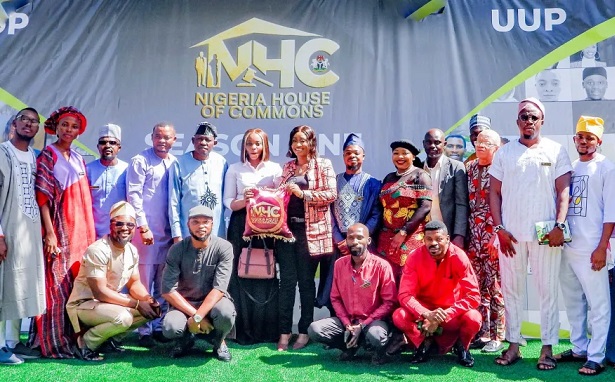
Nigeria House of Commons, a political reality TV show, premiered its first season with a mission to champion inclusiveness for youth and Persons with Disabilities (PWDs) in politics and policy-making.
The programme is an initiative of Africana League, a non-governmental organisation.
The show functions as a mock parliamentary session where young delegates from all 36 states and the Federal Capital Territory (FCT) engage in dynamic debates on critical issues of national policy and governance.
At a press briefing on Thursday, Glory Ukwenga, executive director of Africana League, explained that the show’s purpose is to simulate authentic parliamentary debates on “keenly contested issues of policy”.
She emphasised that the show was designed to be inclusive from the ground up. By selecting a pivotal issue like the Discrimination Against Persons with Disabilities (Prohibition) Act 2018 for one of its pioneering episodes, the programme directly spotlights the need for greater inclusiveness.
“It is globally the first of its kind, not just a show, but the beginning of a movement,” she said.
“It is a mirror of the Nigeria we dream of and a rehearsal of the Africa we desire.
“For decades, many young Nigerians have felt like spectators in their own country’s story. Their ideas on governance are largely unheard, their passion overlooked, and their potential untapped.
“The show is inclusive of young women and men alike. It opens its doors to persons with disabilities whose brilliance and courage have for too long been excluded from the national conversation.
“It is a platform where diversity is not just acknowledged, but celebrated because governance in Nigeria and Africa can only thrive when every citizen has a seat at the table.”
Echoing this call for inclusion, Gracey-Mary Mavic, a participant on the show who is also a PWD and a legal practitioner, provided a critical assessment of Nigeria’s progress. She pointed out that despite the provisions of the 2018 discrimination law, the country has fallen short on implementation.
“It is a known fact that disability inclusion is quite a heavy budget. So the law provides for five years,” she said.
“However, five years elapsed last year, January 2024. We are supposed to be in the implementation stage, but how much has been done? You and I can probably answer these questions better.
“When you look around at public institutions, you cannot count too many institutions that have modified their structures so that they are now accessible for those in wheelchairs and those who have visual impairment like myself.
“It is a matter of fundamental human rights. If you consider persons with disabilities as persons first before their disability, then you will know that their rights are inalienable.”
Watch an episode below:
Copyright 2025 TheCable. All rights reserved. This material, and other digital content on this website, may not be reproduced, published, broadcast, rewritten or redistributed in whole or in part without prior express written permission from TheCable.
Follow us on twitter @Thecablestyle