
Straw, often regarded as a byproduct of agrarian life, assumes a transformative role in the practice of Olu Frank Idoze, creative director of OFI Expressions and Culture Enterprise.
This transformational approach to straw inlay gave rise to Olu Frank’s recent works which he named the Echoes of the Homeland and Dance of the Spirits. These two distinct works, stand as a testament to Olu Frank’s ability to merge material, memory, and meaning with each piece constructed to move beyond just aesthetic appeal but rather to interrogate deeper questions of identity, heritage, and continuity.
His approach in this collection recalls the long-standing African tradition of using organic materials, from raffia weaving to palm frond craft while simultaneously engaging contemporary debates on sustainability and materiality in art.
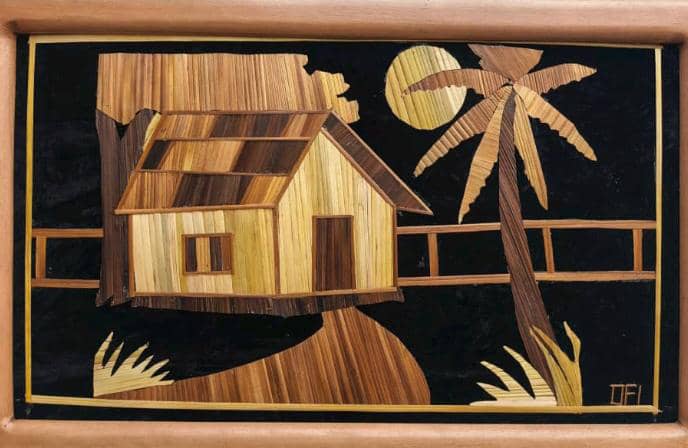
One of the striking pieces in this collection, Echoes of the Homeland anchors itself in nostalgia and rootedness. Through painstaking straw inlay, Idoze crafts a thatched-roof dwelling set against a glowing sun, shielded by the towering palm.
The precision of each straw placement demonstrates not only technical control but also an intimate respect for the medium’s natural tonal variation. Unlike pigment or paint, straw resists manipulation; its strength lies in its organic texture, making Idoze’s handling of depth and warmth here especially striking.
Thematically, the work evokes a quiet dignity of rural life where the palm tree becomes more than botany; it is sustenance, memory, and cultural resilience.
The winding path, almost deceptively simple, guides the eye into the scene, functioning as metaphor, life’s continual journey back to origin. Even the fence, modest and understated, demarcates personal space but never isolates, hinting at the delicate negotiation between community and individuality.
Critically, Echoes of the Homeland succeeds in transcending representation. It does not merely show a hut or a palm but uses them as archetypes of African belonging. However, one could argue that the heavy reliance on symbolism risks oversimplifying rural identity into emblematic motifs.
While the piece is undeniably evocative, its idealization of village life leaves little room for the complexities and contradictions of that world. Yet, perhaps this deliberate idealization is part of Idoze’s intention that is to preserve what is being lost to modernity.
If Echoes of the Homeland dwells in stillness, Dance of the Spirits is its counterpoint, which in description is kinetic, abstract, and dynamic. The composition strips away literalism, presenting elongated, fluid figures whose forms blur between body and spirit. The figures curve and stretch in ways that suggest freedom, vitality, and the joy of movement.
Their twin presence symbolizes harmony, a connection between individuals, community, and the unseen spiritual realm. The flowing lines do more than guide the eye; they evoke continuity, the cyclical passing down of traditions, and the unbroken thread of cultural expression.
This artwork draws deeply from African traditions where dance is not entertainment alone but a sacred language, a form of storytelling, celebration, and communion with ancestors or the divine. In its abstraction, Dance of the Spirits transcends a single ritual and speaks to something universal: the human desire to express, to move, to find freedom through rhythm. Here, straw is less about texture and more about rhythm. Each curve, accentuated against a black void, suggests continuity and upward movement.
The black background operates as more than negative space. It is both infinite and spiritual, framing the straw figures as luminous presences, almost spectral.
This duality, fragility of material against vastness of the unknown heightens the tension in the piece. The twin forms convey harmony, not in symmetry but in relational movement, echoing the communal nature of African dance traditions.
Where Echoes of the Homeland risks idealization, Dance of the Sprits resists containment. Its abstraction allows multiplicity of interpretations which rests on liberation, transcendence, or communion. Its strength lies in this openness. Yet, a critical observation may be that the reduction to two central figures simplifies the layered collectivity often central to African dance, which thrives on multiplicity of bodies, rhythms, and energies. Still, by distilling the dance into essence, Idoze captures something archetypal the human need to embody joy and resilience through movement.
The decision to use straw as a medium cannot be overstated. Straw is modest, biodegradable, and often overlooked, yet in Idoze’s hands it becomes an instrument of permanence. Both works speak to sustainability, not in a didactic sense, but by foregrounding natural material as cultural metaphor rootedness in the earth, respect for resource, and preservation of tradition. The patience required to inlay straw, to allow its texture and natural tones to dictate form, mirrors the themes of endurance and continuity that underpin the works.
Together, Echoes of the Homeland and Dance of the Spirits embody a dialogue between past and present, stillness and movement, representation and abstraction. Idoze does not simply reproduce heritage; he reinterprets it, translating collective memory into material form. The works succeed in engaging viewers emotionally while also inviting reflection on sustainability, cultural identity, and the fragility of memory.
If Echoes whispers of rooted belonging, Dance insists on spiritual motion. In both works, Olu Frank Idoze demonstrates that heritage is neither static nor forgotten, it is lived, remembered, and continually reimagined.
Copyright 2025 TheCable. All rights reserved. This material, and other digital content on this website, may not be reproduced, published, broadcast, rewritten or redistributed in whole or in part without prior express written permission from TheCable.
Follow us on twitter @Thecablestyle