
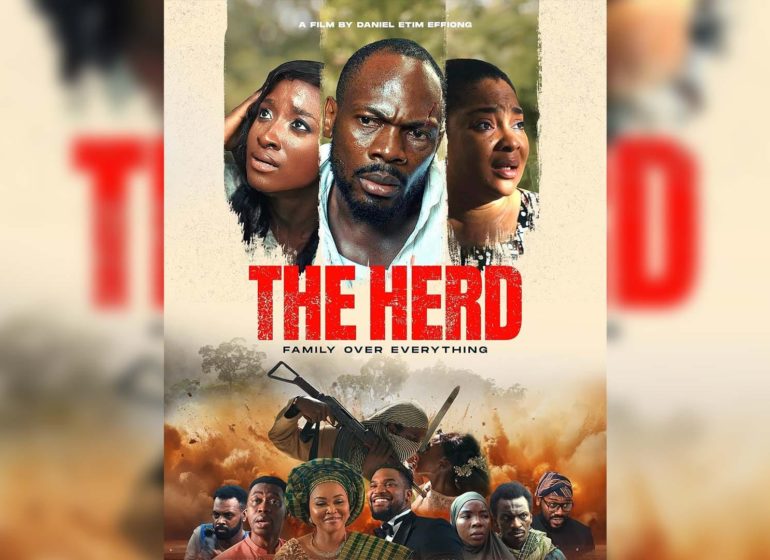
‘‘The Herd,’ the crime thriller marking Daniel Etim-Effiong’s debut as a producer, arrived on Netflix on November 21 after a successful cinema run.
For a first project, Effiong delivers a film that pays close attention to detail, grounding its story in the real fears of everyday Nigerians. ‘The Herd’ turns the country’s rising insecurity into a gripping cinematic experience, exploring its emotional and psychological impact.
Its release also comes at a striking moment, aligning with renewed conversations around banditry. And while the film is not without flaws, it spotlights an urgent national issue and offers a subtle call to action.
SYNOPSIS
In this tense thriller, a joyous wedding turns deadly when a dramatic kidnapping forces the couple and their guests to fight for their lives.
THE STRONG POINTS OF THE FILM
The strongest element of The Herd is its social relevance. The film confronts the growing crisis of insecurity in Nigeria and illustrates just how suddenly an ordinary day can turn traumatic. It captures the unsettling reality that safety is no longer guaranteed and how kidnapping has become a disturbingly familiar threat. A striking example is the scene where the corps member’s younger brother casually recounts escaping a previous abduction, only to fall victim again. Moments like this underline how deeply the problem has seeped into everyday life.
The film also blends its themes well; love, family, and survival are all woven into the larger narrative of kidnapping. This balance gives the story emotional weight while keeping its message grounded in real experiences.
The performances are consistently strong and professional across the entire cast. Every actor embodies their role with believable dialogue and expressive delivery. I was particularly impressed by Ibrahim Abubakar, who played Anas. His performance offered a perfect contrast to the more calculating bandit, Halil, and he held his scenes with a quiet intensity. His hatred, anger, and motivations came through clearly in his tone and actions. Linda Ejiofor also delivered a beautiful performance. Even though most of her scenes were solo, she carried them with a depth that made her emotions relatable and palpable. Overall, every cast member gave their best, making the film engaging, grounded, and easy to connect with.
In terms of the technical elements expected of a crime thriller, ‘The Herd’ also delivers. The special effects during the gunshot sequences are convincing, and the gory, blood-filled moments feel almost real without being excessive. It’s clear that careful attention went into the editing, especially in syncing the actors’ actions and dialogue with the outcomes on screen, from the corpses to the blood splatter. These details help the film maintain its intensity and realism.
The cinematography is also impressive, with camera work that builds tension without feeling chaotic. The lighting is one of its strongest aspects. With most scenes set at night, the film ensures these sequences are well-lit, maintaining clarity while preserving the thriller’s dark tone. Sound and music choices enhance key moments and add emotional depth, while attention to detail is evident in the settings and props.
Although some viewers might criticize the film for portraying certain tribes or religions in a negative light, this choice reflects the harsh realities experienced by many Nigerians facing banditry and kidnappings.
The film does not single out one group; instead, it shows individuals from multiple ethnic groups and religions involved in various forms of wrongdoing. By doing so, it underscores that these societal challenges are not tied to any particular identity but arise from individuals’ choices and actions. This approach adds depth to the story while maintaining its social relevance.
THE WEAK POINTS OF THE FILM
The major flaw of ‘The Herd’ lies in its underdeveloped subplots, many of which are left unresolved. For example, Gosi’s embezzlement of his company’s funds is never fully explained. Why did he commit the fraud, and what did he intend to do with the money? Similarly, while Gosi and Derin are the lead characters, the fate of the other victims connected to their storyline is left unclear, raising questions about narrative consistency.
Even the subplot involving Gosi’s parents pressuring his wife to divorce him after paying the ransom feels rushed and implausible and could have benefited from more context.
There were also moments of inconsistency in the story’s narrative. For instance, the kidnappers initially instructed Adamma to drop the ransom for her husband in Kogi, yet by the end, it is collected in Ekiti. Such discrepancies are distracting and slightly undermine the otherwise tense and immersive storyline.
FINAL VERDICT
‘The Herd’ gets a 7.5/10.
Copyright 2025 TheCable. All rights reserved. This material, and other digital content on this website, may not be reproduced, published, broadcast, rewritten or redistributed in whole or in part without prior express written permission from TheCable.
Follow us on twitter @Thecablestyle