
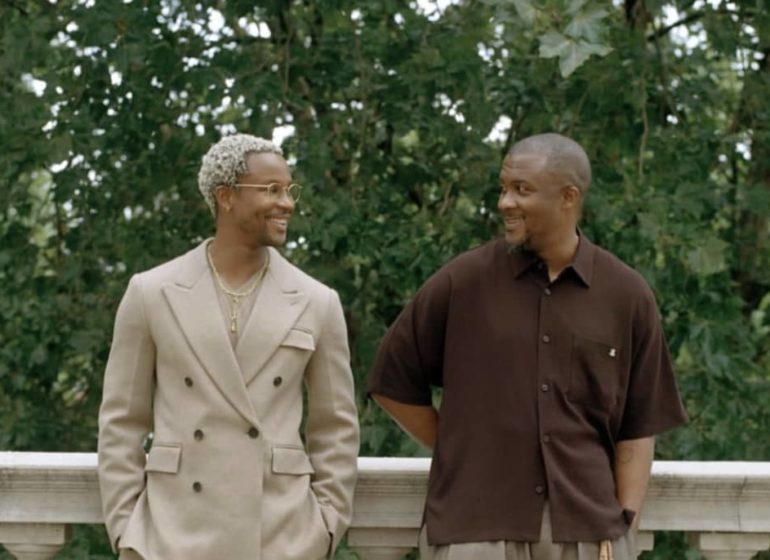
Following its acclaimed screenings at the Cannes and Toronto film festivals, the brothers behind ‘My Father’s Shadow’ — the first Nigerian film selected for Cannes — have revealed the deeply personal true story that fuelled the project.
The film, set against the backdrop of the 1993 presidential election, tells the story of two young brothers — Remi and Akin — who spend a transformative day with their estranged father, Folarin, exploring Lagos for the first time.
For co-writers and brothers Wale Davies, and Akinola Davies, the narrative is a direct reflection of their own childhood.
In a recent Lagos gathering for the film’s premiere, they explained how they infused their fragmented memories of their late father into the script.
“Yes, I think that in terms of the film, the main thing we wanted to focus on was memory and, you know, the fact that these children are spending a day with their father,” Wale stated, clarifying that the film intentionally avoids showing the father’s death.
“How he died, where he died, we leave that open to many people’s imagination,” he said.
“But I think the main things we wanted to just let people take from it are, yeah, it’s just this experience that these boys have had.
“The end of the film, I mean, it wasn’t difficult to write, but it was difficult to watch because, you know, for me personally, it reminds me of the time when my father died at a similar age.
“And the experiences that, as children, you have to go through, see your mother devastated, seeing family members and people like that.
“Like how in death, a lot of people come together to support. So in some ways, maybe some kind of therapy or something, but I do not know.
“So whenever I see the end of the film, it is very tough for me to watch because it reminds me. So it is also my own memories as well that I have kind of put inside.
“For me as a writer, like when you write something, I do not know because I am writing for myself first and foremost. I am writing, I am thinking of the audience and what I have also seen in film and the story arc of the film and all these things.
“But I think when the thing that surprised me the most, actually, after each viewing is people’s emotional reaction to it.
“And I think as children, like there’s a lot of memories that we carry of our family, of our parents, of life that, you know, that sometimes, you know, when you look back, you think, was that really a memory? Was that a dream?
“Because how could I, at four years old or two years old or three years old, remember something so clearly? So I think for me, the response has been really good. The response has been really emotional, even more so than I expected, to be honest. And at Cannes, we got like a long ovation, which is always a good sign.
“I think that actually a lot of the concept of the film came from my brother and me. We have, like I would say, maybe I have about four memories of my father that I remember very clearly. And my brother probably has like one or two. And one of the memories that we both have is very particular.”
On his part, Akinola explained that his frustration with his father initially shaped his view. Named after a man he never knew, Akinola said he felt he was “living in this person’s shadow” and resented the struggle his mother faced as a single parent.
“I guess most specifically, my perspective was that I am named after my father, I’m named after someone I never really knew,” he said.
“So, quite literally, I’m having to live in this person’s shadow. And I always found, I was always very angry with the prospect of that because it always seemed that this person was just this larger than life character that I’ll never be able to live up to.
“And actually, I was also just more concerned with the well-being of my mother. Obviously, he did not mean to pass, but I was upset because I always felt that we were put in a position where we were from a single-parent household.
“And I just saw my mother had to struggle to provide for us. So for me, he represented the brunt of a lot of my frustrations. But I think the older I get, the more I see many doubts about the whole situation.
”But I think that’s how we came within the conversation of how we’re going to write this film, which is completely collaborative. It’s like, okay, we need to come at it from honest perspectives, because that’s what also informs the writing.
”I think someone asked the question before about how you’re creating art in a Nigerian context. I think art is just really a reflection of the truth. And then, depending on how you frame it, depending on the music you put, depending on how you see the world, that can be viewed as art. To someone in Nigeria, maybe it’s something quite basic. But someone in the rest of the world may have never seen those images before. So in that version, it’s art. So I guess it’s a mixture of how you present the truth.
“But ultimately, it’s the fact that you’re dealing with the truth that makes you feel something specifically, basically.”
View this post on Instagram
The production faced substantial hurdles.
Co-producer Funmbi Ogunbanwo described shooting in Nigeria as “complicated and complex,” citing major obstacles with logistics, location access, management, and even basic utilities.
“For a lot of us, it was really our first time. And it stretched all of us. I was not this complex when I was very black when I was shooting. But it was also because, you know, we were doing something that we hadn’t done before, but we cared so deeply about,” Ogunbanwo said.
“The challenges with shooting in Nigeria range from logistics to management to basic utilities and sometimes even to just access to locations.”
Copyright 2025 TheCable. All rights reserved. This material, and other digital content on this website, may not be reproduced, published, broadcast, rewritten or redistributed in whole or in part without prior express written permission from TheCable.
Follow us on twitter @Thecablestyle