
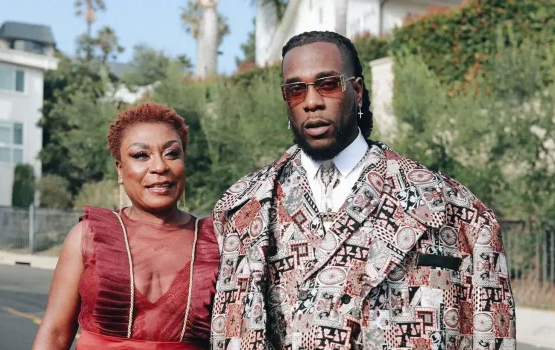
Burna Boy, the Afrofusion singer, has revealed that his anchor to reality remains the steadfast influence of his family and the community that raised him.
In a recent interview with Rolling Stone, the Grammy-winning superstar opened up about the role his background plays, describing his family as his “compass” and his community as the “mirror” that reflects his true self.
“Family is my compass, community is my mirror. When things get loud, those are the voices I trust. The people who knew you before the noise will tell you the truth with love. That balance keeps me human. The work is global, but the roots are local. I water the roots first,” he said.
The hitmaker, born Damini Ogulu, placed special emphasis on the pivotal role of his mother Bose Ogulu, who doubles as his manager.
For Burna, she is more than a business partner; she is a vital link to his core identity.
The singer traced his personal geography, acknowledging the different influences that have shaped him.
“My mum is not just my manager, she’s the voice that reminds me of who I am when the noise gets too loud,” he said.
“My family, my community keeps me accountable. Port Harcourt made me, Lagos shaped me, the world introduced me. But home keeps me human.”
Burna also spoke about the deep, almost “spiritual” connection he forges with his global audience.
He said he finds immense motivation in watching fans from vastly different cultures sing his songs word for word, even if they don’t understand the Yoruba or Pidgin lyrics.
“People might not speak the language, but they understand the feeling when the drums land and the bass breathes. I love watching a crowd go from curious to connected in one hook. And I enjoy the small details: hearing a local accent sing a line perfectly,” he said.
“Noticing which rhythms make a particular city move, seeing flags in the crowd and families dancing three generations deep. Those moments remind me of why I chose to do this.Then there is the connection. Seeing people who don’t even speak Yoruba or Pidgin singing word for word, that’s spiritual.
“It tells me the emotion is translating even if the language isn’t. I’ve also enjoyed discovering how each crowd moves differently. It’s energy for energy and that’s what I feed off. The diaspora carries home inside them, food, slang, rhythm, memory.
“And when the music hits, those memories wake up. I’ve seen people cry on the rail and then laugh two songs later. I’ve seen parents put their kids on their shoulders to hear a line about pride or resilience. For me, that’s bigger than a show; it’s a reunion.”
Copyright 2025 TheCable. All rights reserved. This material, and other digital content on this website, may not be reproduced, published, broadcast, rewritten or redistributed in whole or in part without prior express written permission from TheCable.
Follow us on twitter @Thecablestyle