
BY TERFA TILLEY-GYADO
Much has been made about the streaming giants Netflix and Amazon leaving Nigerian shores and scaling back commissions, but Kemi Adetiba’s ‘To Kill a Monkey‘ shows that bold home-grown stories still have global pull.
The blistering new Netflix series affirms her place in the pantheon of Africa’s greatest auteurs. This eight-part cyber-noir thriller vibrates with the energy of a filmmaker at the height of her powers, weaving together strands of classic cinema while delivering a uniquely Nigerian vision of moral decay in the digital age.
A Nollywood Scarface for the Yahoo Boy Era
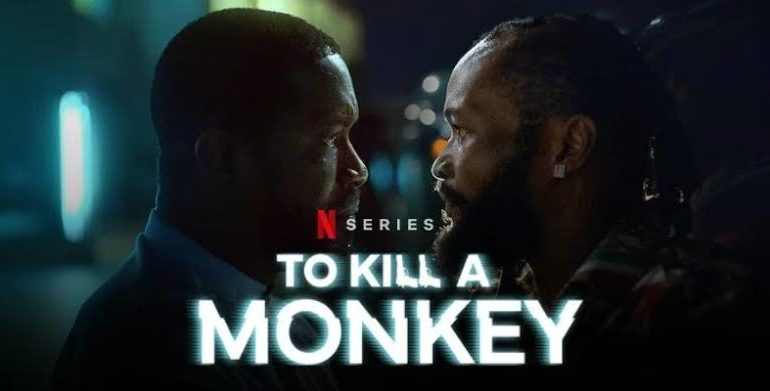
At the heart of To Kill a Monkey is the twisted bromance between Efemini (William Benson) and Oboz (Bucci Franklin). Franklin and Benson’s chemistry crackles with the same live-wire intensity as Al Pacino and Steven Bauer in Scarface, or Tupac and Omar Epps in Juice. The way Adetiba charts the disintegration of Efemini and Oboz’s co-dependency recalls Scorsese’s anatomisation of toxic brotherhood in Mean Streets and Goodfellas. Yet the cybercrime milieu is wholly of this moment in time in Nigeria, tapping into the anxieties and aspirations of a generation raised on Get Rich-or-Die-Trying hustler mythology. Efemini is the struggling everyman pulled into “Yahoo” schemes and ever-deeper compromise. Oboz is the charismatic accelerant.
Nobody Does Crime Like Kemi Adetiba
If her 2018 feature King of Boys doubled down her status as a major filmmaking talent, To Kill a Monkey cements Adetiba as a modern master of the crime epic. Her King of Boys saga already drew favourable comparisons to Francis Ford Coppola’s Godfather trilogy for its novelistic scope and operatic power struggles. Here she proves equally adept at the pressure-cooker intimacy of Michael Mann or the late Tony Scott. Adetiba directs with a souped-up intensity, juicing familiar beats from the crime playbook with an electrifying jolt of Naija grit. Oboz’s meltdown in a crowded restaurant tips its hat to Pacino’s unhinged “say goodnight to the bad guy” scene, also set in a restaurant, from Scarface, but the scene’s Lagos specificity is unmistakable. Adetiba is a crate-digger of genre tropes, sampling classic riffs with the dexterity of a Hip-hop turntablist, always finding a fresh Nigerian flip.
From the first stark opening to the breathless final montage, the pacing never sags. Editor Daniel Anyiam (alias “tundecutz”) cuts with the rhythm of a drumline, cross-matching handheld intimacy with slick aerial pulls that keep the tension coiled. Each episode lands on a cliff-edge that feels earned rather than manufactured, and the flash-forwards are timed so expertly that even repeat viewings reveal new narrative breadcrumbs. Much like Adetiba’s earlier opus King of Boys 2, To Kill a Monkey began life as a feature film before evolving into a series. It proved to be a rewarding creative decision, as the longer television format provides Adetiba the canvas to really delve into character psychology and motivation in a way that a two-hour film rarely allows.
A Rogues Gallery of Knockout Performances
William Benson’s Efemini is all nervous energy, shoulders permanently hunched as if expecting the next blow. Bucci Franklin’s Oboz delivers pidgin with an almost lyrical quality: menace in every line, yet always betraying deep-seated insecurity. Their shifting dynamic is the show’s emotional engine. Stella Damasus, Bimbo Akintola and Chidi Mokeme round out a veteran ensemble whose micro-reactions speak volumes, even when dialogue is sparse.
As compelling as the central duo is, the women frequently walk off with whole scenes. Stella Damasus, as Efemini’s long-suffering wife Nosa, gives a slow-burn performance that recalls Sharon Stone in Casino without ever echoing it. Sunshine Rosman finally gets a role beyond “fine face” casting; she brings steel, sly sensuality and genuine danger as the quintessential gangster’s moll. Lilian Afegbai, playing Oboz’s wife, Idia, punctures scenes with switchblade wit and flint-eyed tenderness.
Adetiba’s most vivid creations are often her criminals, and that imbalance shows. The investigators sometimes lack equivalent heft, so the moral cat-and-mouse can feel one sided. Bimbo Akintola is the exception. As Inspector Ogunlesi she layers authority with vulnerability, making you wish the series spent almost as much time with her as it does with the rogues.
Pidgin as poetry
The script’s language crackles with an expressive Benin Pidgin that feels lived-in rather than performative. Adetiba deploys code-switching to show class fissures: Efemini’s street-level Pidgin sits uneasily beside the Queen’s English of corporate Lagos, underscoring his identity tug-of-war. The cadences are almost musical when deployed by Bucci Franklin and Lilian Afegbai in particular. The on-screen couple turn everyday phrases into threatening lullabies, proof that language, not just violence, can bruise.
A muscular, melodic score
Composer Oscar Heman-Ackah (Adetiba’s beau) delivers a propulsive soundtrack that fuses contemporary Naija riffs with sub-bass pulses more common in Scandinavian noir. The leitmotif built around Efemini’s growing paranoia is both haunting and catchy, echoing in the viewer’s ear long after the credits roll.
Lenscraft and colour science
Although the principal cinematographer credit goes to South African DoP Kabelo Thathe, the Adetiba siblings’ collaboration is unmistakable. Remi Adetiba’s photographic sensibility—as producer and on-set framing consultant (not to mention occasional voice artist)—shapes a palette of sickly neons and washed daylight that mirrors Efemini’s moral disorientation. Night exteriors pop with anxious greens, while a recurring teal filter suggests the insidious glow of computer screens. The result is an aesthetic that feels international without losing Lagos’s gritty texture.
New Benchmark for Nigerian Prestige TV
On a five-star scale, To Kill a Monkey earns the full constellation. Its editing is economical yet electric, the performances live in the muscle rather than the line, and its pidgin dialogue sings with authenticity. Heman-Ackah’s score and the Adetiba’s visuals knit everything into a bingeable package that proves Nollywood can deliver prestige television on its own terms. When the inevitable awards season chatter begins, do not be surprised if this monkey climbs right to the top of the tree.
Copyright 2025 TheCable. All rights reserved. This material, and other digital content on this website, may not be reproduced, published, broadcast, rewritten or redistributed in whole or in part without prior express written permission from TheCable.
Follow us on twitter @Thecablestyle